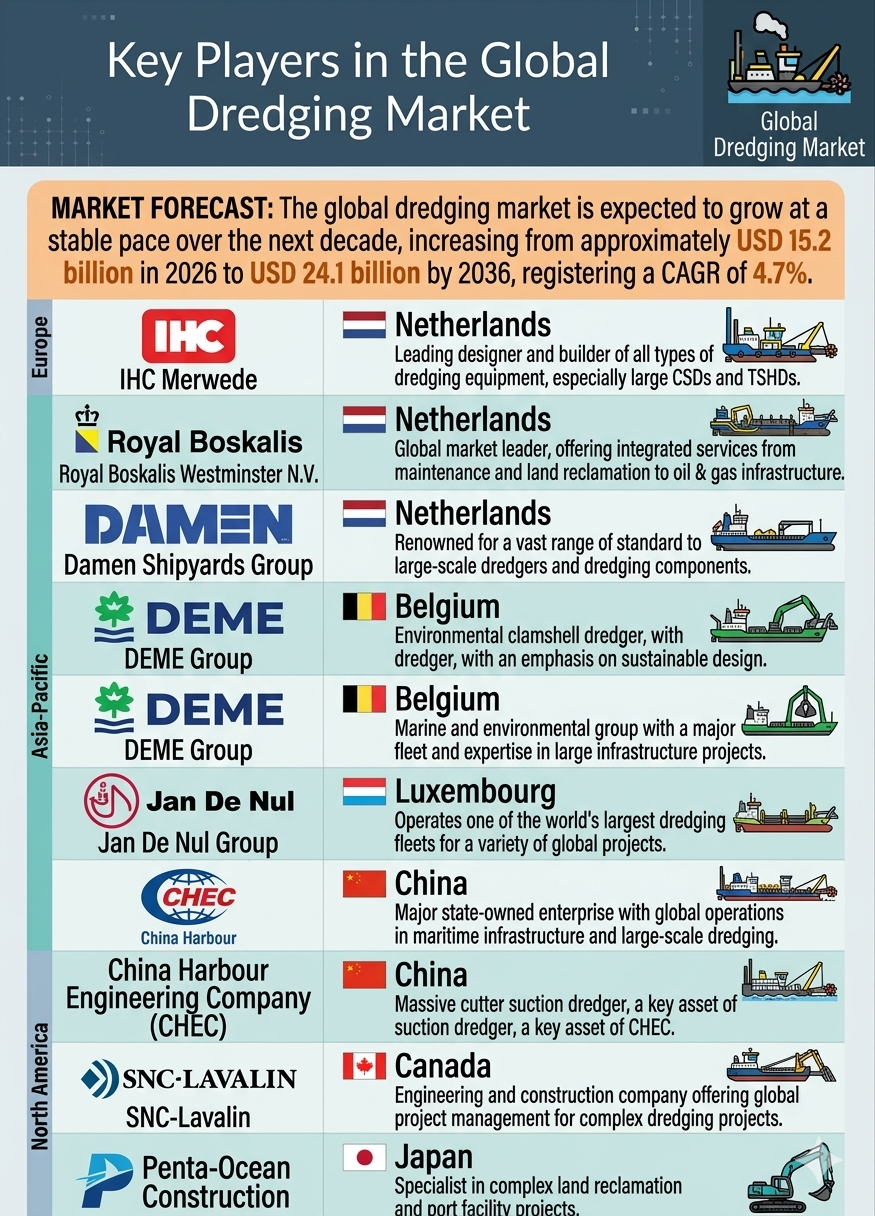
The global dredging market is expected to grow at a stable pace over the next decade, increasing from approximately USD 15.2 billion in 2026 to USD 24.1 billion by 2036, registering a CAGR of 4.7%, according to the latest analysis by Future Market Insights (FMI).
Market expansion is being driven by rising investments in port infrastructure, coastal protection, inland waterways, and urban development projects. Governments and private stakeholders are increasingly focusing on maintaining navigable waterways, expanding trade capacity, and protecting coastlines from erosion and climate change impacts.
Although conventional dredging practices remain widely adopted due to their cost efficiency and operational familiarity, the industry is gradually transitioning toward more advanced, environmentally sustainable dredging technologies. Increasing regulatory scrutiny and ecological considerations are encouraging the use of precision dredging, sediment management systems, and low-impact equipment.
Dredging Market Snapshot (2026–2036)
- Market size in 2026: USD 15.2 billion
- Market size in 2036: USD 24.1 billion
- CAGR (2026–2036): 4.7%
- Leading application type: Capital dredging (~42.8% share)
- Largest end-use segment: Ports & harbors (~36.5% share)
- Key growth regions: Asia Pacific, Europe, North America
- Fastest-growing countries: China, India, United States, Netherlands, Brazil
Momentum in the Market
Starting at approximately USD 15.2 billion in 2026, the dredging market is projected to witness consistent growth driven by expanding global trade and maritime logistics. By 2030, increased investments in port modernization, shipping channel deepening, and offshore infrastructure are expected to significantly boost demand.
Between 2030 and 2036, growth is further supported by rising climate resilience initiatives, including coastal protection and flood prevention projects. The integration of automation, GPS-based dredging systems, and real-time monitoring technologies is also improving efficiency and precision in dredging operations.
The Reasons Behind the Market's Growth
The demand for dredging services is increasing as countries prioritize maritime trade efficiency, urban coastal development, and environmental management. Dredging plays a critical role in maintaining waterway depth, reclaiming land, and ensuring safe navigation for increasingly large vessels.
Government investments in infrastructure development and international trade expansion are major growth drivers. Additionally, climate change-related challenges such as rising sea levels, sedimentation, and coastal erosion are accelerating the need for dredging activities worldwide.
Growing offshore energy projects, including wind farms and oil & gas exploration, are also contributing to sustained demand for dredging services, particularly for seabed preparation and cable installation.
Top Segment Application Type
Capital Dredging Leads with Around 42.8% Share
Capital dredging dominates the market, driven by large-scale infrastructure projects such as port expansion, new harbor construction, and land reclamation. These projects require extensive dredging to create new navigation channels and support economic development.
End-Use Category: Ports & Harbors Anchor Market Demand (~36.5% Share)
Ports and harbors remain the largest end-use segment due to the continuous need for maintenance dredging and expansion projects. Other key end-use sectors include offshore energy, mining, urban development, and environmental remediation.
Regional Development: Asia Pacific, Europe, and North America Drive Expansion
Asia Pacific continues to lead the global dredging market, supported by rapid industrialization, expanding trade routes, and significant investments in port infrastructure.
- India: 5.6% CAGR driven by inland waterway development and port modernization
- China: 5.3% CAGR fueled by large-scale maritime infrastructure projects
- United States: 4.9% CAGR supported by coastal restoration and navigation maintenance
- Netherlands: 4.6% CAGR reflecting expertise in advanced dredging technologies
- Brazil: 4.4% CAGR driven by port expansion and commodity exports
India’s growth is particularly influenced by initiatives such as Sagarmala and inland water transport development, boosting dredging demand across major ports and river systems.
Challenges, Trends, Opportunities, and Drivers
Drivers
- Increasing global trade and port infrastructure expansion
- Rising demand for coastal protection and flood control
- Growth in offshore energy and marine construction projects
Opportunities
- Adoption of eco-friendly and low-impact dredging technologies
- Expansion of inland waterways and smart port initiatives
- Increasing investments in climate resilience infrastructure
Trends
- Shift toward automated and precision dredging systems
- Integration of digital monitoring and sediment analysis tools
- Focus on sustainable sediment management practices
Challenges
- Stringent environmental regulations and permitting processes
- High operational and equipment costs
- Environmental concerns related to marine ecosystems disruption
Country Growth Outlook (CAGR 2026–2036)
- India: 5.6%
- China: 5.3%
- United States: 4.9%
- Netherlands: 4.6%
- Brazil: 4.4%
The Competitive Environment
The dredging market remains moderately consolidated, with key players competing based on technological capabilities, project execution efficiency, and environmental compliance.
Leading companies include Royal Boskalis Westminster N.V., Van Oord N.V., DEME Group, Jan De Nul Group, China Communications Construction Company (CCCC), and Great Lakes Dredge & Dock Corporation. These companies focus on large-scale infrastructure projects, advanced dredging fleets, and sustainable operational practices to maintain a competitive edge.
For a comprehensive strategic outlook and detailed insights into emerging infrastructure and maritime development trends shaping the industry through 2036, readers can explore the full report on the official Future Market Insights website - https://www.futuremarketinsights.com/reports/dredging-market