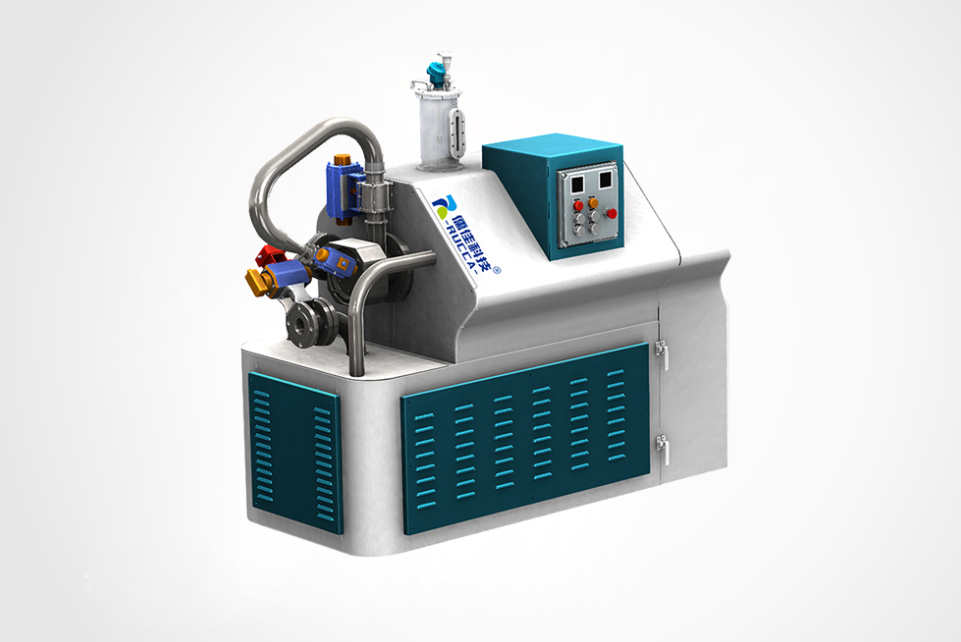
In industries such as coatings, chemicals, pharmaceuticals, and food processing, dispersion quality is a decisive factor in final product performance. Even small inconsistencies in particle size distribution can affect stability, texture, reactivity, and overall product quality.
Traditional batch dispersing equipment has been widely used for decades, but it often comes with limitations—such as dust emissions, uneven mixing, high energy consumption, and inefficiencies in large-scale production.
To overcome these challenges, the Inline Dispersing System has emerged as a more advanced solution. By enabling continuous, closed-loop, and dust-free processing, it significantly improves efficiency, safety, and product consistency in powder-liquid mixing applications.
What Makes Inline Dispersing Systems Different?
Unlike conventional batch systems, inline dispersing technology operates in a continuous process. Materials are fed, mixed, and dispersed in a closed pipeline system, which ensures:
- Faster processing cycles
- Consistent particle size distribution
- Reduced manual handling
- Lower contamination risk
- Improved production efficiency
This makes it especially suitable for industries requiring high precision and stable quality output.
Vacuum Dust-Free Powder Suction: Cleaner and Safer Operation
One of the most important innovations in modern systems like those developed by Rucca is the vacuum dust-free powder suction system.
This technology allows powders to be directly drawn from multiple feeding sources, including:
- Powder silos
- Small bags
- Hoppers
- Ton bags
- Barrels
All of this is achieved without releasing dust into the working environment.
Key Benefits
- Eliminates airborne dust pollution
- Improves workplace safety
- Reduces material waste
- Maintains raw material purity
- Enhances production cleanliness
For industries where hygiene and safety are critical—such as pharmaceuticals and food processing—this feature is especially valuable.
High Powder Suction Capacity for Industrial Efficiency
Modern inline dispersing systems are designed for high-throughput production.
For example, advanced systems from Rucca can achieve powder suction capacities of up to 200 kg/min, enabling rapid processing of large material volumes.
Advantages of High Capacity Processing
- Faster production cycles
- Reduced downtime
- Improved scalability
- Lower operational costs
- Higher production efficiency
This capability is essential for manufacturers aiming to expand output without significantly modifying existing production lines.
Achieving Fine and Uniform Slurry Quality
Particle fineness is a key indicator of dispersion quality, especially in chemical, coating, and pharmaceutical applications.
Advanced inline dispersing systems can typically achieve slurry particle sizes below 40 microns, depending on material properties.
Benefits of Fine Dispersion
- Improved product stability
- Enhanced texture and consistency
- Better chemical reactivity
- Higher end-product performance
Uniform dispersion ensures that every batch meets strict quality standards, reducing variability in production.
Energy Efficiency: Supporting Sustainable Manufacturing
Energy consumption is a major concern in industrial processing.
Compared with traditional dispersing systems, modern inline dispersing technology can reduce energy usage by more than 50%.
Why This Matters
- Lower production costs
- Reduced carbon footprint
- Improved environmental compliance
- Better alignment with sustainability goals
Energy-efficient systems are becoming increasingly important as industries shift toward greener manufacturing practices.
Dust-Proof Cleaning and Handling of Difficult Materials
Processing challenging materials—such as sticky, dusty, or difficult-to-wet powders—has always been a technical challenge.
Advanced inline dispersing systems include dust-proof cleaning process inductors that:
- Prevent dust leakage
- Ensure clean material transfer
- Reduce contamination risks
- Improve system reliability
This design also simplifies maintenance and cleaning, helping operators maintain stable long-term performance.
Quick Discharge and Material Recycling Advantages
Efficient material handling is another key advantage of inline dispersing systems.
These systems are designed to ensure that raw materials are:
- Fully incorporated into the process
- Quickly discharged after processing
- Less likely to adhere to equipment surfaces
Operational Benefits
- Faster turnaround time
- Reduced material waste
- Improved resource utilization
- Easier recycling and recovery
This closed-loop approach supports both economic efficiency and environmental sustainability.
Key Advantages of Inline Dispersing Technology
In summary, modern inline dispersing systems offer several important benefits:
- Continuous and stable processing
- Dust-free operation
- High throughput capacity
- Fine and uniform dispersion quality
- Significant energy savings
- Easy maintenance and cleaning
- Improved workplace safety
These advantages make them ideal for modern high-efficiency production environments.
Final Thoughts
As industrial production continues to evolve toward higher efficiency, better safety, and greater sustainability, the Inline Dispersing System is becoming an essential piece of equipment in powder-liquid processing industries.
With innovations such as vacuum dust-free suction, high-capacity feeding, energy-efficient operation, and precise dispersion control, systems developed by companies like Rucca are helping manufacturers improve product quality while reducing operational costs and environmental impact.
In the long term, adopting advanced inline dispersing technology is not just an equipment upgrade—it is a strategic step toward smarter and more sustainable manufacturing.
https://www.ruccagroup.net/the-advantages-of-inline-dispersing-systems.html