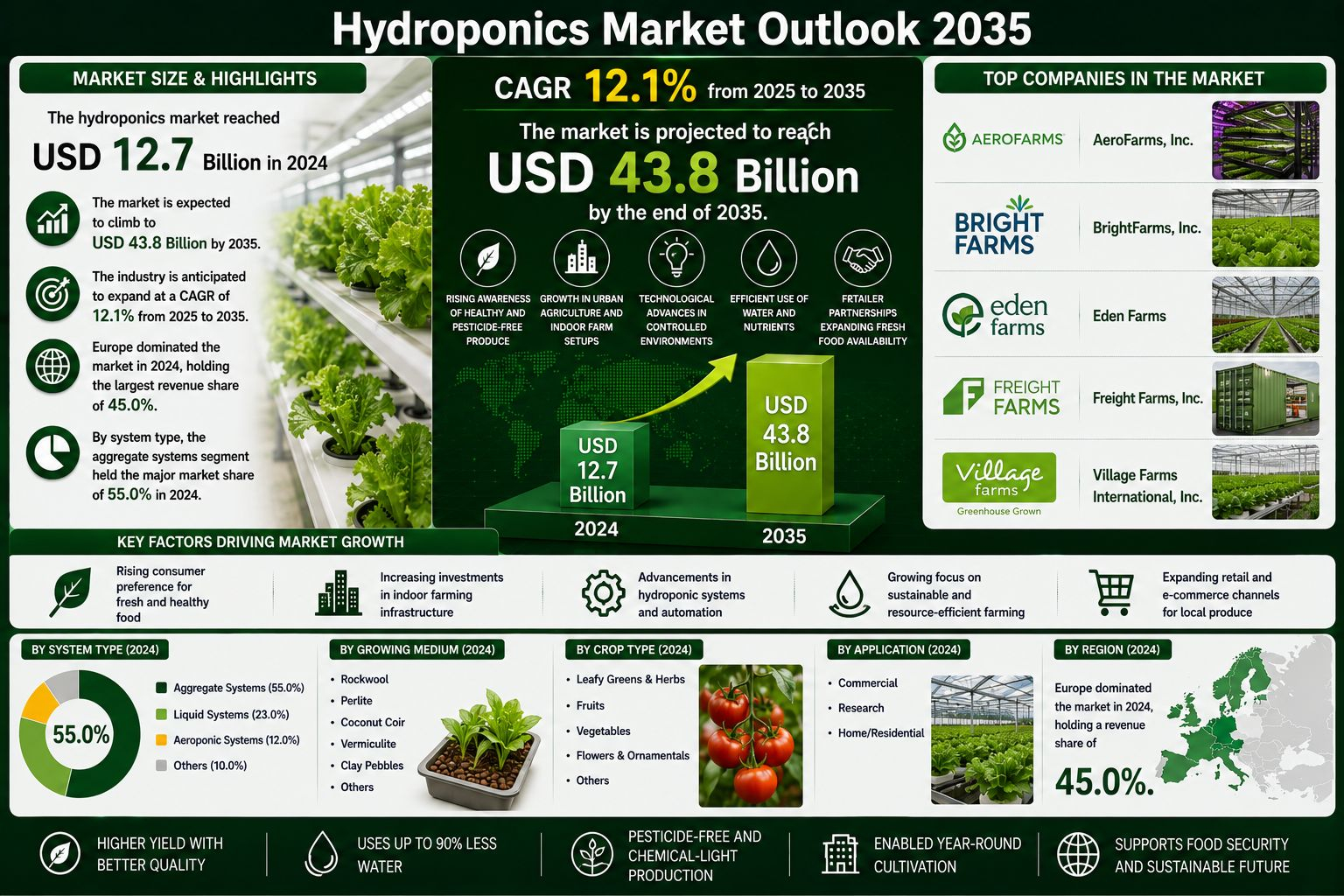
The global hydroponics market size was valued at USD 12.7 billion in 2024 and is projected to reach USD 43.8 billion by 2035, expanding at a CAGR of 12.1% from 2025 to 2035. The hydroponics industry is experiencing robust growth due to rising awareness of sustainable farming practices, increasing demand for pesticide-free produce, rapid urbanization, technological advancements in controlled-environment agriculture, and expanding investments in indoor farming systems.
Analysts’ Viewpoint on Global Hydroponics Market
The hydroponics market is undergoing rapid transformation as the global agricultural sector seeks resource-efficient alternatives to conventional farming. Climate change, water scarcity, declining arable land availability, and growing consumer demand for pesticide-free and locally produced food are driving adoption of hydroponic cultivation systems worldwide.
Increasing investments in vertical farming, controlled-environment agriculture (CEA), precision farming technologies, and automation are improving crop productivity while reducing resource consumption. Hydroponic systems enable year-round cultivation independent of weather conditions, making them particularly attractive for urban regions and areas facing agricultural challenges.
Furthermore, advancements in LED lighting, climate control systems, nutrient delivery technologies, sensors, and artificial intelligence are improving operational efficiency and lowering production costs. As hydroponic farming becomes increasingly scalable and commercially viable, the market is expected to witness strong growth across both developed and emerging economies.
Hydroponics Market Introduction
Hydroponics is a method of cultivating plants without soil by supplying nutrients directly through water-based solutions. Plants are grown in nutrient-rich water, often supported by inert growing media such as rockwool, coconut coir, perlite, vermiculite, or expanded clay pellets.
Hydroponic farming allows precise control over:
- Water usage
- Nutrient delivery
- Oxygen levels
- Temperature
- Humidity
- Light exposure
- Carbon dioxide concentration
This controlled growing environment improves crop yields, accelerates growth cycles, and significantly reduces water consumption compared to traditional farming methods.
Hydroponic systems are commonly used to cultivate:
- Lettuce
- Spinach
- Kale
- Tomatoes
- Cucumbers
- Peppers
- Herbs
- Berries
- Flowers
- Medicinal plants
Modern hydroponic operations integrate advanced technologies including automated fertigation systems, climate-control equipment, environmental sensors, LED grow lights, water purification systems, and farm management software.
Market Drivers
Urbanization and Limited Arable Land Driving Hydroponics Adoption
Rapid urbanization and shrinking agricultural land availability are among the most significant factors driving hydroponics market growth.
As urban populations continue to expand globally, food demand is increasingly concentrated in metropolitan areas while productive farmland near cities becomes scarce due to residential and industrial development.
Hydroponic systems offer a practical solution by enabling high-density food production in:
- Urban warehouses
- Rooftops
- Greenhouses
- Shipping containers
- Vacant industrial facilities
- Indoor vertical farms
Unlike conventional agriculture, hydroponic farming produces significantly higher yields per unit area while minimizing land requirements.
Governments and urban planners are increasingly supporting urban agriculture initiatives to strengthen local food security, reduce transportation costs, and improve supply chain resilience. These factors are accelerating investments in commercial hydroponic facilities worldwide.
Furthermore, hydroponic systems consume substantially less water through closed-loop irrigation and precision fertigation technologies, making them particularly attractive in water-stressed regions.
Population Growth Increasing Demand for Food Security
Growing global population continues to place significant pressure on food production systems.
As arable land and freshwater resources remain limited, governments and agricultural stakeholders are seeking innovative solutions capable of producing larger quantities of food with fewer natural resources.
Hydroponics provides several advantages that directly address food security concerns:
- Year-round crop production
- Reduced dependency on weather conditions
- Lower water consumption
- Higher crop yields
- Faster growth cycles
- Reduced pest and disease exposure
- Improved crop consistency
Controlled-environment agriculture allows production in regions where conventional farming may be difficult due to:
- Water scarcity
- Poor soil quality
- Extreme climates
- Urban expansion
The ability to deliver reliable, predictable, and localized food production is making hydroponics an increasingly important component of future food security strategies.
Market Opportunity: Automation and Smart Farming Technologies
The integration of automation, artificial intelligence, and precision agriculture technologies presents significant growth opportunities for the hydroponics industry.
Modern hydroponic facilities increasingly utilize:
- AI-powered monitoring systems
- Automated nutrient management
- Climate-control software
- Remote farm management platforms
- IoT-based sensors
- Predictive analytics
- Robotic harvesting systems
These technologies help optimize resource usage, reduce labor costs, improve crop yields, and enhance operational efficiency.
As the cost of automation technologies continues to decline, adoption among commercial hydroponic operators is expected to increase substantially throughout the forecast period.
Aggregate Systems Segment Dominates Global Hydroponics Market
By System Type
Aggregate systems accounted for approximately 55.0% of global hydroponics market revenue in 2024, making them the leading system category.
Aggregate systems utilize growing media such as:
- Rockwool
- Coconut coir
- Perlite
- Vermiculite
- Expanded clay pellets
These systems are widely preferred due to their operational simplicity, reliability, and compatibility with commercial greenhouse production.
Major aggregate system techniques include:
- Grow bag systems
- Hanging bag techniques
- Pot techniques
- Trench or trough systems
- Drip irrigation systems
Commercial growers favor aggregate systems because they provide:
- Consistent moisture retention
- Strong root support
- Improved nutrient management
- Greater resilience against operational disruptions
- Ease of integration with greenhouse automation systems
The widespread adoption of substrate-based cultivation in major greenhouse-producing countries such as the Netherlands, Spain, and Italy continues to strengthen the segment's market leadership.
Regional Outlook of Hydroponics Market
Europe Leads Global Hydroponics Industry
Europe accounted for approximately 45.0% of global hydroponics revenue in 2024, making it the largest regional market.
The region benefits from:
- Advanced greenhouse infrastructure
- Strong agricultural technology ecosystem
- High consumer demand for fresh produce
- Government support for sustainable agriculture
- Extensive research and development capabilities
- Well-established supply chains
Countries such as the Netherlands, Spain, Germany, France, and Italy have developed sophisticated protected-cultivation industries that support widespread hydroponics adoption.
The Netherlands remains a global leader in greenhouse technology, climate-control systems, fertigation solutions, and hydroponic research. The country's highly automated agricultural sector serves as a model for controlled-environment farming worldwide.
Spain complements this leadership through large-scale greenhouse production operations that supply fresh produce across Europe throughout the year.
European Union initiatives promoting sustainable agriculture, resource efficiency, and food security continue to support hydroponics market expansion across the region.
Asia Pacific Emerging as a High-Growth Market
Asia Pacific is expected to witness substantial growth throughout the forecast period due to:
- Rapid urbanization
- Rising food demand
- Limited agricultural land availability
- Growing investments in indoor farming
- Government support for food security initiatives
- Increasing adoption of controlled-environment agriculture
Countries including China, India, Japan, South Korea, Singapore, and Australia are actively investing in hydroponic and vertical farming technologies to address future food supply challenges.
Competitive Landscape
The hydroponics market is characterized by increasing investments in technology innovation, automation, and large-scale commercial farming operations.
Leading companies are focusing on:
- Vertical farming expansion
- Advanced irrigation technologies
- AI-driven farm management systems
- Energy-efficient lighting solutions
- Sustainable nutrient delivery systems
- Strategic partnerships with retailers and food distributors
Many market participants are also developing turnkey farming solutions designed to simplify hydroponics adoption for commercial growers and institutional customers.
Key Companies Operating in the Market
Major companies profiled in the hydroponics market include:
- AeroFarms, Inc.
- AMCO Produce Inc.
- BrightFarms, Inc.
- Eden Farms
- Emirates Hydroponics Farms
- Freight Farms, Inc.
- Green Sense Farms Holdings
- Hollandia Produce Inc.
- Millennium Pacific Greenhouse Ltd.
- Platinum Produce Co.
- Soave Enterprises LLC
- Swissradies Company
- Thanet Earth Limited
- Upward Farms
- Village Farms International, Inc.
- Other Key Players
Recent Developments
July 2025 – Edible Garden AG Inc.
Edible Garden AG launched the first USDA-certified organic hydroponically grown basil sold as a living root-on plant. The company reported significant water savings compared with conventional farming methods while improving product shelf life and reducing food waste.
June 2025 – GrowGeneration Corp.
GrowGeneration Corp. acquired Viagrow, a supplier of hydroponic and gardening equipment generating approximately US$ 3 million in annual revenue. The acquisition expands GrowGeneration's presence in home gardening markets and strengthens its proprietary product portfolio across major retail channels.
Future Outlook
The global hydroponics market is expected to experience significant expansion as the agricultural sector increasingly embraces sustainable and resource-efficient food production systems. Rising urbanization, growing food security concerns, water scarcity challenges, and consumer demand for fresh pesticide-free produce will continue driving adoption worldwide.
Technological innovations in automation, artificial intelligence, climate control, LED lighting, and precision nutrient management are expected to improve operational efficiency and profitability, making hydroponics increasingly attractive for commercial-scale production.
As governments, investors, retailers, and consumers prioritize sustainable agriculture and resilient food supply chains, hydroponics is expected to become a critical component of future global food production systems.