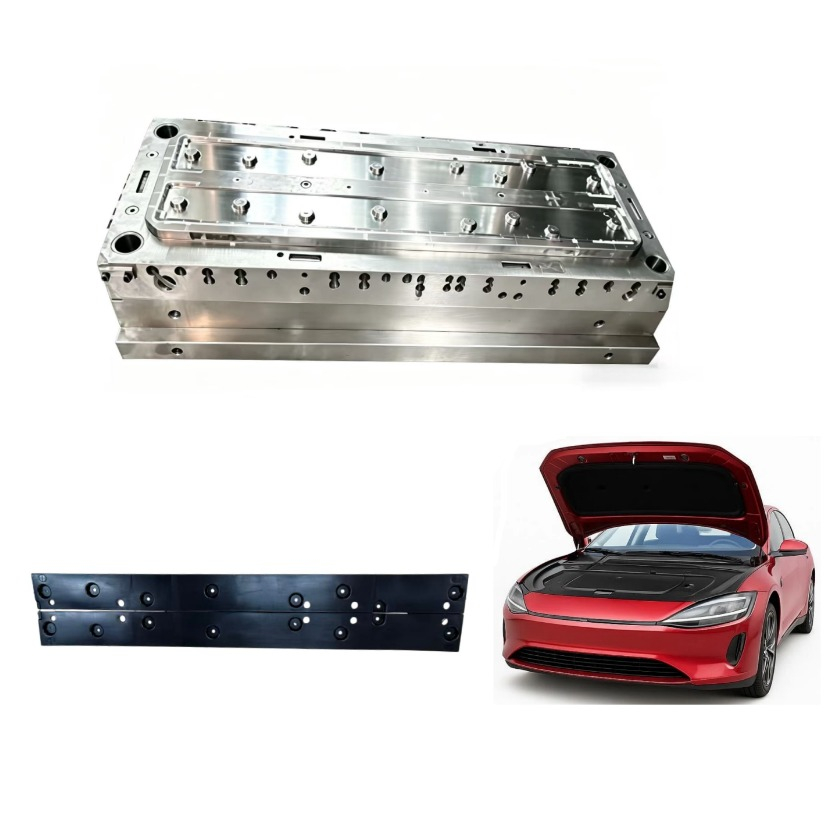
Driving conditions that involve uneven terrain, gravel roads, construction zones, or unpaved surfaces significantly increase exposure of the vehicle’s underside. Mechanical assemblies such as the oil sump, differential housing, exhaust routing, and transmission casing remain highly vulnerable to sudden impact loads.
A Car Underbody Protection Plate is often integrated into vehicles used in off-road or semi-off-road environments to reduce mechanical failure risk caused by direct ground contact or flying debris.
Impact Load Behavior and Structural Response
When a vehicle travels over rocky terrain, the underbody may experience localized impact forces exceeding 5 kN depending on speed and obstacle geometry. Without protective shielding, these forces are transferred directly to metal housings or fluid reservoirs.
A properly engineered protection plate redistributes these forces across a larger surface area. Instead of a single point impact, energy is spread along reinforced ribs or stamped geometries within the plate structure.
Steel variants commonly use thickness between 3 mm and 6 mm, allowing deformation without penetration. Aluminum-based systems often increase thickness to 4 mm–8 mm to compensate for lower yield strength. Composite plates may extend beyond 10 mm while relying on layered fiber reinforcement for energy absorption.
Off-Road Driving Scenarios
In rocky environments, skid contact occurs frequently during approach and departure angles. A Car Underbody Protection Plate prevents direct scraping of engine components when ground clearance is temporarily reduced.
During muddy or sandy conditions, repeated underbody contact introduces abrasive wear. Protective plates reduce long-term erosion of factory-installed plastic covers and wiring conduits.
In forest or trail environments, fallen branches or hidden stones may cause sudden impact shocks. Underbody shielding absorbs these shocks before they reach structural mounts or fluid reservoirs.
Mounting Reinforcement and Load Distribution
Installation design plays a critical role in impact performance. Most systems use 4–8 mounting points connected to subframe rails. These points are engineered to handle both vertical and lateral force transfer.
Bolt grades commonly range from 8.8 to 10.9 tensile class, with torque specifications between 20 Nm and 60 Nm depending on vehicle class. Reinforced brackets are often added near front and mid sections to improve torsional rigidity.
Some systems include cross-beam reinforcements that connect left and right mounting rails. This improves stability when the plate experiences uneven loading, such as when one side contacts an obstacle before the other.
Thermal and Environmental Considerations
Off-road operation increases thermal variation in underbody components. A Car Underbody Protection Plate influences airflow direction, sometimes retaining heat near the engine bay while protecting from direct splash cooling.
Drainage channels or ventilation cutouts are commonly integrated to prevent water accumulation. This reduces corrosion risk and maintains consistent airflow during prolonged use.
Dust accumulation is another factor. Off-road driving environments generate fine particulate matter that can accumulate on flat surfaces. Design features such as angled ribs or slotted openings help reduce buildup.
Material Performance Comparison in Off-Road Use
Steel systems provide strong resistance against repeated rock strikes. Aluminum systems provide a balance between protection and weight reduction, making them suitable for mixed terrain usage.
Composite systems are more commonly used in urban-to-light-trail transitions, where protection needs are moderate but noise and vibration control are important.
Each system type is evaluated based on impact resistance, fatigue life, and deformation tolerance rather than single-event strength.
Practical Role in Vehicle Longevity
Repeated underbody exposure without protection often leads to gradual damage accumulation rather than immediate failure. Fluid leaks, sensor misalignment, and wiring abrasion are common long-term issues.
A Car Underbody Protection Plate reduces these risks by creating a controlled barrier layer, extending service intervals and reducing unexpected mechanical downtime.