INTRODUCTION
Choosing the right Modular Ophthalmic OT Manufacturers is an important decision for hospitals and eye care centers planning a safe, efficient, and controlled surgical environment. An ophthalmic operation theatre requires more than modular walls and ceilings; it involves coordinated planning of airflow, HVAC, filtration, electrical systems, medical gases, lighting, flooring, equipment integration, infection-control requirements, and maintenance. Hospitals should therefore evaluate manufacturers based on engineering expertise, product quality, customization capabilities, installation experience, testing procedures, documentation, after-sales support, and their ability to deliver a complete solution.
Understanding Modular Ophthalmic Operation Theatres
A modular ophthalmic operation theatre is a specially designed surgical environment intended for procedures such as cataract surgery, retinal surgery, corneal procedures, glaucoma surgery, refractive procedures, and other ophthalmic interventions.
Unlike a conventional room converted into an operating theatre, a modular OT is designed using coordinated components that can provide:
- Hygienic interior surfaces
- Controlled environmental conditions
- Efficient airflow management
- High-efficiency filtration
- Easy cleaning
- Integrated utilities
- Equipment compatibility
- Improved workflow
- Long-term maintainability
The manufacturer plays a major role in bringing these systems together into a functional surgical environment.
1. Evaluate Industry Experience
Hospitals should first examine the manufacturer's experience in healthcare infrastructure.
A company with experience in ophthalmic OTs is more likely to understand the specialized requirements of eye surgery environments.
Hospitals can ask about:
- Number of completed OT projects
- Types of healthcare facilities served
- Experience with ophthalmic theatres
- Experience with modular construction
- HVAC integration experience
- Laminar airflow projects
- Testing and commissioning capabilities
Relevant experience can help reduce design errors and improve project coordination.
2. Check Engineering and Design Expertise
A reliable manufacturer should have a dedicated engineering and design approach rather than simply supplying modular panels.
The design team should consider:
- Room dimensions
- Surgical workflow
- Equipment placement
- Airflow requirements
- HVAC capacity
- Pressure relationships
- Electrical loads
- Medical gas requirements
- Lighting
- Ceiling services
- Maintenance access
The design should be developed around the hospital's actual clinical and technical requirements.
3. Assess Customization Capabilities
Every hospital has different building conditions and surgical requirements.
A good manufacturer should be capable of customizing the OT according to:
- Available space
- Existing infrastructure
- Surgical procedures
- Equipment selection
- Airflow requirements
- Hospital workflow
- Future expansion
- Budget considerations
Standardized components can provide efficiency, but customization is often necessary for an optimized ophthalmic OT.
4. Examine the Quality of Modular Panels
The modular wall and ceiling system forms the physical enclosure of the theatre.
Hospitals should examine:
- Panel construction
- Surface finish
- Joint design
- Sealing
- Durability
- Cleanability
- Resistance to moisture
- Resistance to commonly used cleaning agents
- Maintenance requirements
Smooth, durable, and easy-to-clean surfaces are particularly important in healthcare environments.
5. Evaluate Flooring Solutions
OT flooring should support hygiene, durability, and safe movement.
Depending on the project, flooring may be selected based on:
- Seamless installation
- Chemical resistance
- Easy cleaning
- Slip resistance
- Durability
- Electrical characteristics
- Compatibility with healthcare cleaning procedures
The manufacturer should be able to explain why a particular flooring solution is appropriate for the intended application.
6. Review HVAC Integration Expertise
HVAC is one of the most important technical systems in an operating theatre.
A manufacturer should understand how HVAC affects:
- Temperature
- Humidity
- Air changes
- Pressure
- Air distribution
- Filtration
- Environmental stability
Hospitals should determine whether the manufacturer can coordinate HVAC engineering with the modular OT design.
A poorly coordinated HVAC system can affect overall theatre performance.
7. Examine Laminar Airflow Capabilities
For projects requiring controlled airflow over a critical surgical area, hospitals should evaluate the manufacturer's expertise in laminar airflow systems.
The project team should understand:
- HEPA filtration
- Airflow velocity
- Air distribution
- Filter housing
- Air balancing
- Pressure relationships
- Monitoring
- Testing
The manufacturer should also explain how the airflow system will interact with surgical lights, operating microscopes, equipment, and personnel.
8. Ask About HEPA Filtration
HEPA filtration can play an important role in reducing airborne particulate contamination in controlled environments.
Hospitals should ask about:
- Filter efficiency
- Filter specifications
- Housing construction
- Filter sealing
- Integrity testing
- Replacement procedures
- Pressure-drop monitoring
The focus should be on the complete filtration system rather than the filter alone.
9. Review Electrical Infrastructure
Modern ophthalmic OTs may require multiple electrical connections for surgical and monitoring equipment.
A manufacturer should coordinate:
- Medical-grade electrical outlets
- Dedicated circuits
- Earthing
- Backup power
- UPS connections where required
- Control panels
- Equipment connections
- Surgical lighting
Electrical systems should be designed according to the facility's requirements and applicable safety standards.
10. Consider Medical Gas Integration
Depending on the clinical requirements, the OT may need medical gas systems such as oxygen, medical air, and vacuum.
Hospitals should confirm whether the manufacturer can coordinate:
- Pipeline connections
- Gas outlets
- Isolation arrangements
- Equipment locations
- Testing
- Documentation
Medical gas work should be performed and tested by appropriately qualified professionals.
11. Evaluate Equipment Integration
Ophthalmic surgery often involves specialized equipment.
Examples include:
- Operating microscopes
- Phacoemulsification systems
- Surgical lasers
- Operating tables
- Patient monitors
- Surgical lights
- Visualization systems
The modular OT design should accommodate these systems without creating unnecessary conflicts with airflow, utilities, staff movement, or maintenance access.
12. Review Infection-Control Features
The OT should support the hospital's infection-control strategy.
Important design characteristics can include:
- Smooth surfaces
- Sealed joints
- Easy-to-clean finishes
- Controlled airflow
- Appropriate filtration
- Proper room pressure
- Reduced dust accumulation
- Hygienic doors
- Suitable ceiling construction
Hospitals should ask manufacturers to explain how their design supports cleaning and environmental control.
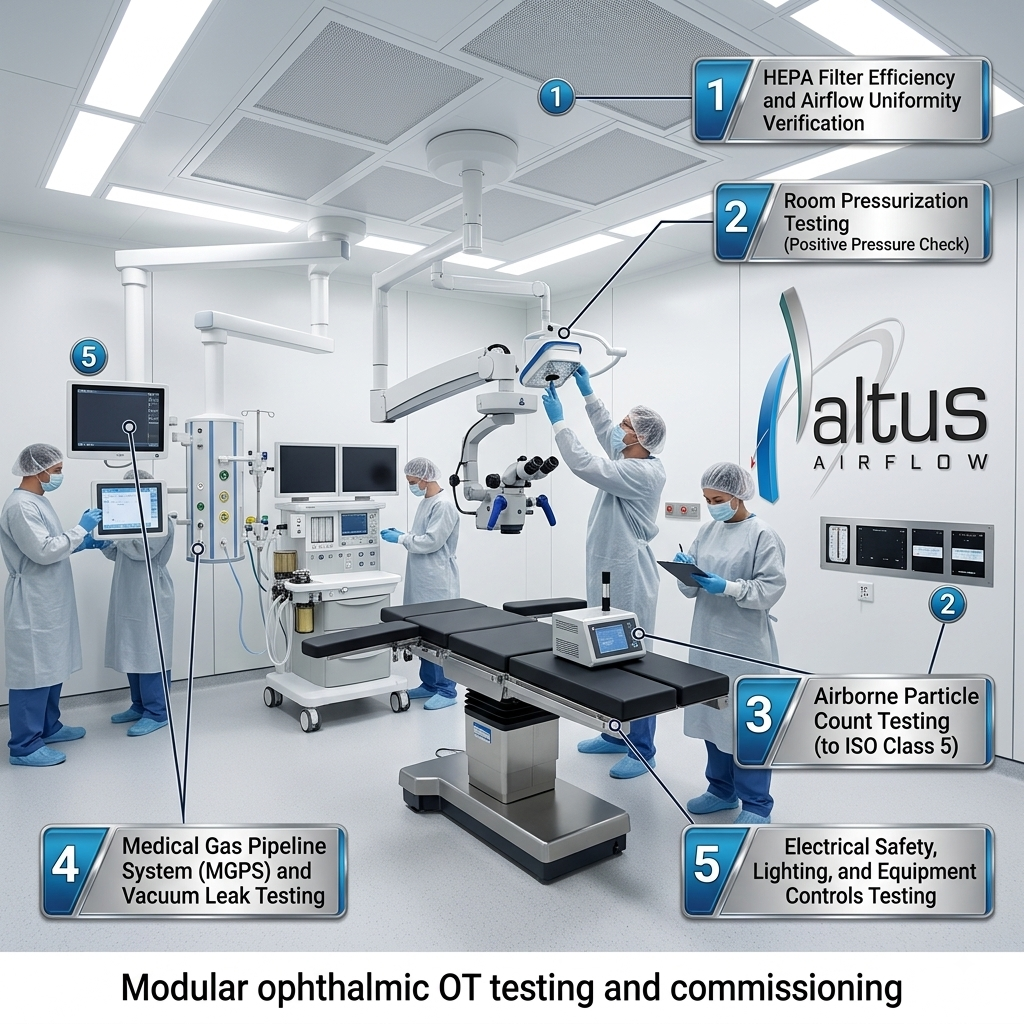
13. Check Testing and Commissioning Procedures
Installation should not be considered complete simply because construction is finished.
A professional project should include appropriate testing and commissioning.
Depending on the design, testing may cover:
- Airflow velocity
- Air volume
- HEPA filter integrity
- Room pressure
- Temperature
- Humidity
- Particle levels
- Electrical safety
- Medical gas performance
- Alarm systems
Hospitals should ask for a clear testing and commissioning plan before project execution.
14. Verify Documentation
Technical documentation is essential for future operation and maintenance.
A manufacturer should be capable of providing relevant documents such as:
- Approved drawings
- Equipment specifications
- HVAC documentation
- Filter specifications
- Testing reports
- Commissioning reports
- Calibration records
- Warranty documents
- Maintenance instructions
Complete documentation helps hospital engineering teams manage the facility effectively.
15. Examine Project Management Capabilities
A modular ophthalmic OT involves multiple technical disciplines.
These can include:
- Civil work
- Modular installation
- HVAC
- Electrical systems
- Medical gases
- Air filtration
- Controls
- Surgical equipment
- Testing
A manufacturer capable of coordinating these activities can help reduce communication gaps and scheduling problems.
16. Ask About Turnkey Capabilities
Hospitals may prefer working with a provider that can manage multiple aspects of the project.
A turnkey approach may include:
- Requirement assessment
- Site survey
- Design
- Engineering
- Material procurement
- Manufacturing
- Installation
- HVAC integration
- Electrical work
- Medical gas coordination
- Airflow installation
- Testing
- Commissioning
- Handover
The exact scope should be clearly defined in the project agreement.
17. Compare Project Timelines Carefully
Hospitals should compare proposed schedules, but the lowest timeline should not automatically be considered the best.
A realistic schedule should allow time for:
- Design approvals
- Procurement
- Manufacturing
- Site preparation
- Installation
- Integration
- Testing
- Commissioning
A rushed project may create quality or coordination problems.
18. Evaluate After-Sales Support
The relationship with the manufacturer should continue after handover.
Hospitals should ask about:
- Preventive maintenance
- Emergency support
- Filter replacement
- HVAC servicing
- Airflow testing
- Sensor calibration
- Technical assistance
- Spare parts
- Warranty support
Reliable after-sales service can improve long-term system availability.
19. Consider Maintenance Requirements
The OT should be designed for practical maintenance.
Maintenance personnel should have suitable access to:
- Filters
- Fans
- HVAC components
- Sensors
- Control panels
- Electrical systems
- Service connections
A design that is difficult to maintain can increase operational costs over time.
20. Check Safety and Compliance Awareness
Hospitals should choose a manufacturer that understands relevant healthcare engineering and safety requirements.
Depending on the project, the design may need to consider applicable requirements relating to:
- HVAC
- Electrical safety
- Medical gases
- Fire safety
- Cleanroom principles
- Infection control
- Building services
- Environmental monitoring
The manufacturer should be able to identify which standards and project-specific requirements apply rather than making unsupported compliance claims.
21. Review Previous Project Performance
Hospitals can request references or project information where appropriate.
Useful questions include:
- Was the project completed on schedule?
- Were testing requirements completed?
- Was documentation provided?
- How has the OT performed after handover?
- Was maintenance support available?
- Were post-installation issues resolved?
Past performance can provide valuable insight into the manufacturer's reliability.
22. Compare Total Project Value
Hospitals should avoid selecting a manufacturer based solely on the initial quotation.
The total project value can depend on:
- Material quality
- Energy consumption
- Maintenance costs
- Filter replacement
- Equipment reliability
- Warranty
- Service support
- Expected lifespan
- Testing and commissioning
A slightly higher initial investment may provide better long-term value when the solution is properly engineered.
23. Assess Energy Efficiency
An efficient OT design can help control long-term operating expenses.
Manufacturers can consider:
- Efficient HVAC equipment
- Appropriate fan selection
- Variable-speed controls
- Optimized airflow
- Efficient lighting
- Proper insulation
- Automated monitoring
Energy efficiency should always be balanced against the environmental requirements of the theatre.
24. Consider Future Expansion
Hospitals may expand their surgical services in the future.
The design can therefore consider:
- Additional equipment
- Future utility requirements
- Maintenance access
- Additional monitoring
- Technology upgrades
- Replacement of major components
Planning for future requirements can reduce the need for major modifications later.
25. Use a Structured Selection Checklist
Before selecting a manufacturer, hospitals can create a comparison checklist.
| Selection Factor | What to Evaluate |
|---|---|
| Experience | Healthcare and ophthalmic OT projects |
| Engineering | Design and technical capabilities |
| Materials | Quality, hygiene, durability |
| HVAC | Integration and environmental control |
| Laminar airflow | Filtration, airflow, testing |
| Electrical | Safety and equipment integration |
| Medical gases | Installation and testing capability |
| Testing | Commissioning and performance verification |
| Documentation | Drawings, reports, manuals |
| Maintenance | Service and preventive maintenance |
| Support | Warranty and technical assistance |
| Project management | Coordination and schedule control |
This approach allows hospitals to compare providers more objectively.
26. Common Mistakes Hospitals Should Avoid
Hospitals should avoid choosing a provider solely because of:
- Lowest quotation
- Fastest promised completion
- Attractive product presentation
- Generic specifications
- Limited project experience
They should instead evaluate technical competence, product quality, project execution, testing, documentation, and long-term support.
27. Why the Right Manufacturer Matters
An ophthalmic OT is a critical clinical environment. Its performance depends on how well the building envelope, HVAC, filtration, utilities, equipment, and workflow are integrated.
The right manufacturer can help ensure that:
- The design matches clinical requirements
- Systems are properly coordinated
- Installation follows approved drawings
- Testing is completed
- Documentation is available
- Maintenance can be performed efficiently
This creates a stronger foundation for reliable OT operation.
Conclusion
Hospitals can choose the best Modular Ophthalmic OT Manufacturers by evaluating healthcare experience, engineering capabilities, material quality, HVAC and filtration expertise, customization, equipment integration, testing, documentation, project management, maintenance, and after-sales support. A structured comparison based on technical performance and long-term value is more reliable than selecting a provider based solely on price or installation speed. The manufacturer should demonstrate an understanding of ophthalmic surgical requirements and provide a coordinated solution from design through commissioning. Altus Airflow supports healthcare facilities with engineered modular OT solutions focused on controlled environments, airflow management, hygienic construction, system integration, and dependable project execution.
Frequently Asked Questions
1. How should hospitals select Modular Ophthalmic OT Manufacturers?
Hospitals should evaluate Modular Ophthalmic OT Manufacturers based on healthcare experience, engineering expertise, modular construction quality, HVAC integration, filtration capabilities, testing, documentation, project management, and after-sales support.
2. Why is experience important when choosing a manufacturer?
Experienced Modular Ophthalmic OT Manufacturers are more likely to understand the specific requirements of ophthalmic surgery, including airflow, equipment integration, electrical systems, medical gases, infection-control considerations, and maintenance access.
3. What should hospitals check about modular OT materials?
Hospitals should evaluate the durability, cleanability, surface finish, joint sealing, moisture resistance, and maintenance requirements of materials supplied by Modular Ophthalmic OT Manufacturers.
4. Do Modular Ophthalmic OT Manufacturers provide HVAC integration?
Many Modular Ophthalmic OT Manufacturers can coordinate HVAC systems with modular OT construction, filtration, pressure management, temperature control, humidity control, and airflow distribution, depending on their project scope.
5. How important is laminar airflow expertise?
Laminar airflow can be an important part of environmental control in selected ophthalmic OTs. Hospitals should choose Modular Ophthalmic OT Manufacturers that understand HEPA filtration, airflow distribution, testing, and coordination with surgical equipment.
Read Our Previous Blog------>How long does it take to complete an Ophthalmic Modular OT With Laminar Airflow?