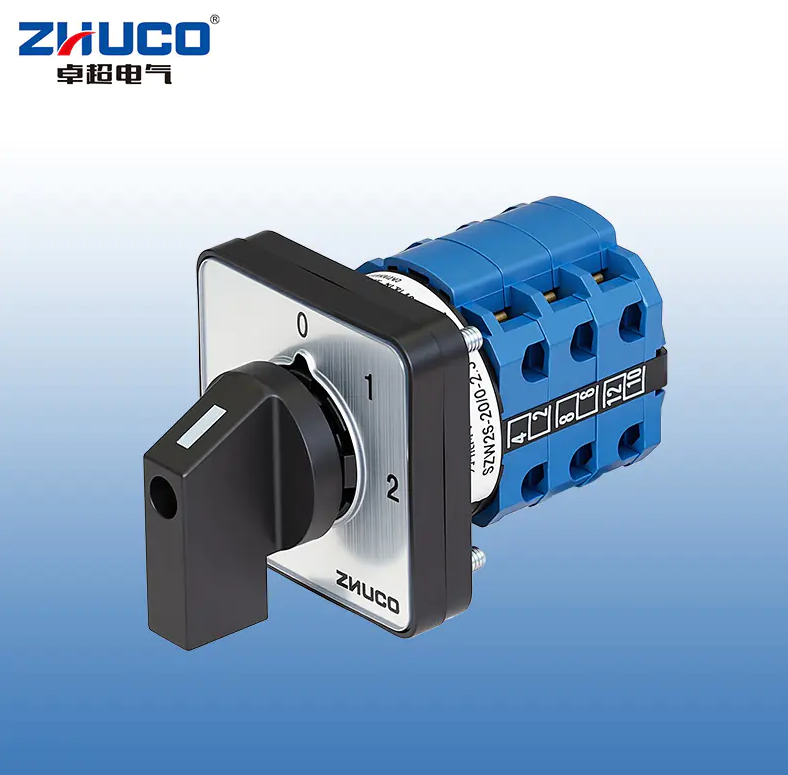
A circuit changeover switch gives an electrical system the ability to move a load from one supply to another without leaving the equipment unpowered for long. The device sits between two incoming sources and a single outgoing circuit. By moving a lever, rotating a handle, or triggering an automatic mechanism, the switch disconnects the first source and connects the second. This action keeps lights on, motors running, or control panels alive when the primary supply fails or needs to be taken offline.
The internal layout centers on a set of moving contacts that travel between fixed terminals. In a typical double-throw arrangement the common terminal links to the load while two outer terminals connect to the separate sources. When the switch is in one position the load receives power from source A; when it moves to the opposite position the load receives power from source B. A center-off position is often included so both sources can be isolated if required.
Mechanical design keeps the transition deliberate. Detents or spring loading hold the handle firmly in each position, preventing accidental movement. Some versions use a break-before-make sequence so the first source opens completely before the second source closes. This prevents the two supplies from connecting to each other through the switch, an event that could cause circulating currents or damage. Other designs allow a brief overlap if the sources are synchronized, though that approach appears mainly in specialized automatic units.
Contact materials and size match the expected current and voltage. Larger contacts handle higher loads without excessive heating. Arc-control features stretch and cool the arc that forms when the contacts separate under load, protecting the surfaces from rapid wear. The enclosure shields the live parts and provides a clear indication of which source is active, often through a labeled faceplate or position window.
Wiring enters the circuit changeover switch through dedicated terminals for each source and for the load. Clear marking reduces the chance of reversed connections during installation. Once the conductors are secured, the switch becomes the single point that decides which supply feeds the downstream circuit. Operators can change sources by hand when planned work is needed, or an automatic controller can sense voltage loss and drive the switch to the alternate supply.
In buildings, workshops, and small industrial setups the circuit changeover switch supports continuity. A generator can take over when the utility feed drops, or a secondary transformer can supply power while the primary unit is inspected. The switch itself remains a straightforward mechanical or electro-mechanical device whose job is simply to route voltage from one path to another.
The practical value lies in that controlled transfer. By providing a defined path for each source and a reliable way to select between them, the circuit changeover switch keeps essential loads supplied when one supply is unavailable. Its action is visible, positive, and limited to the basic task of changing the circuit from one feed to the other.