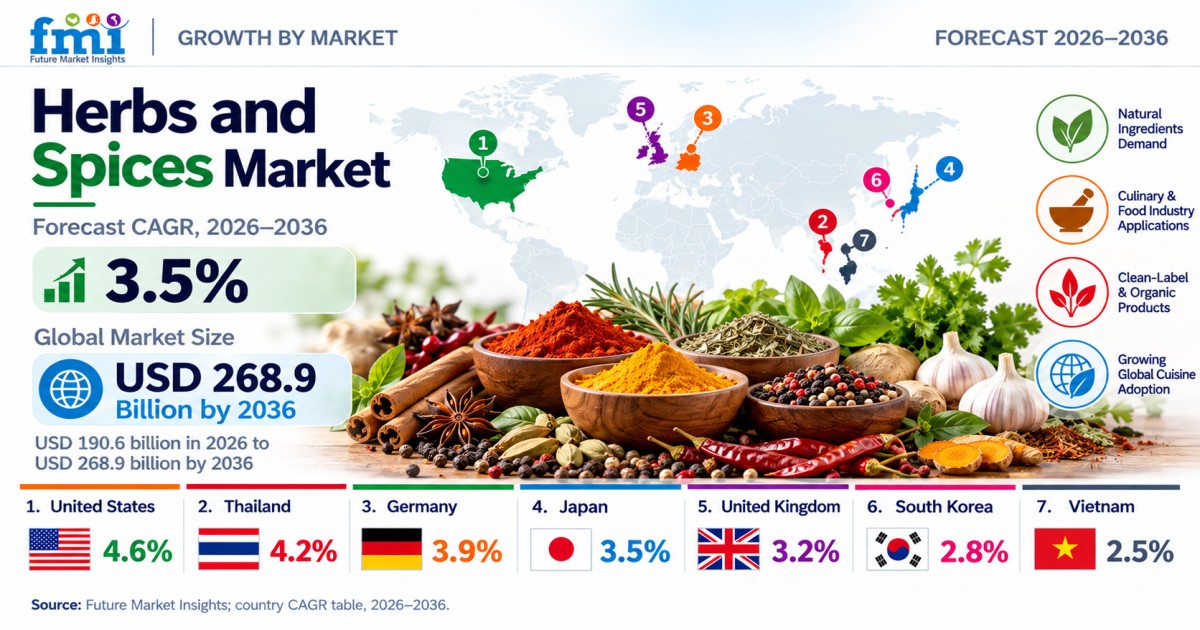
The global herbs and spices market is projected to grow from USD 190.6 billion in 2026 to USD 268.9 billion by 2036, registering a compound annual growth rate (CAGR) of 3.5%, according to Future Market Insights (FMI).
Get detailed market forecasts, competitive benchmarking, and pricing trends:
https://www.futuremarketinsights.com/reports/sample/rep-gb-12536
Seasoning ingredients remain important across sauces, snacks, beverages, bakery products and meat preparations. Food manufacturers rely on repeatable flavor profiles and ingredients that can be measured and blended consistently across production runs. FMI expects spices to account for 94.3% of product-type revenue in 2026, reflecting their broad use in commercial food production.
For suppliers, the opportunity extends beyond offering a wide range of flavors. Consistent taste, documented origin, microbial testing and reliable delivery are important considerations when manufacturers qualify ingredients for regular production.
Food processing sustains demand for seasoning ingredients
The continued production of prepared foods and meat products supports recurring demand for herbs and spices. The U.S. Department of Agriculture's Economic Research Service projected per-capita red meat and poultry availability at 226 pounds in 2025 and 227 pounds in 2026.
Food manufacturers also continue to introduce new flavor profiles into established product lines. In January 2026, Kerry Group released its 2026 Taste Charts, identifying dominant, growing and emerging flavors across food and beverage categories. These developments illustrate the importance of flavor development to product formulation, although individual seasoning requirements vary by application.
Dry spice formats are particularly relevant to large-scale manufacturing because they can be weighed, stored and blended using established production equipment. Suppliers that combine consistent specifications with suitable processing formats can better address the purchasing requirements of industrial customers.
Where growth is fastest
FMI's country forecasts indicate that the United States and Thailand will lead the profiled markets in projected growth between 2026 and 2036.
- United States — 4.6% CAGR: A broad range of imported food ingredients and established processed-food applications support demand. Buyers continue to evaluate origin documentation, contaminant records and flavor consistency when approving suppliers.
- Thailand — 4.2% CAGR: Food processing and export-oriented manufacturing support seasoning demand. The USDA reported in June 2026 that Thailand imported USD 23.5 billion of agricultural products in 2025.
- Germany — 3.9% CAGR: A substantial food-processing industry supports recurring purchases of seasoning ingredients for meat products, bakery goods, snacks and convenience foods.
- Japan — 3.5% CAGR: Food and beverage manufacturers provide a steady application base, while familiar flavor profiles remain important when suppliers change ingredient origins.
- United Kingdom — 3.2% CAGR: Imported herbs and spices serve food manufacturing and foodservice demand. Import compliance, provenance and contaminant documentation remain important during supplier qualification.
- South Korea — 2.8% CAGR: Imported ingredients support domestic food processing, making accurate labeling, inspection records and consistent quality important to sourcing decisions.
- Vietnam — 2.5% CAGR: Growth in food processing and foodservice creates additional seasoning applications, while suppliers must maintain product identity and quality through grinding and blending.
These figures represent projected country-level growth rates, not the countries' shares of global market revenue.
What leads the market
Three segments account for substantial shares of the herbs and spices market in 2026, according to FMI.
- Spices — 94.3% of product-type revenue: Broad applications in sauces, snacks, prepared meals and meat products support the segment's leading position.
- Food — 32.7% of end-use demand: Direct incorporation into commercial recipes supports repeated purchases by food manufacturers.
- Powder and granules — 52.1% of form revenue: Dry formats support consistent measuring, storage and blending on established manufacturing lines.
FMI also projects direct sales to account for 37.8% of sales-channel demand and conventional products to represent 41.7% of nature-category revenue in 2026.
These percentages refer to separate market classifications and should not be added together.
The hurdle: contaminant control and source approval
A spice lot can meet a buyer's flavor specifications but still fail to qualify for production if its safety documentation is incomplete. Microbial contamination, pesticide residues and other contaminants can delay approval or prevent a shipment from entering a particular market.
The UK Food Standards Agency's September 9, 2026, National Monitoring Plan sampling priorities for imported foods identify risks including microbial hazards, aflatoxins and Sudan dyes in specified herb and spice products.
For manufacturers and suppliers, these requirements make traceability and testing important parts of procurement. A change in crop origin may also require renewed sensory and quality checks before an ingredient can be used in an established recipe.
FMI identifies treated spice formats and application support as opportunities for suppliers. Testing dosage, heat intensity and flavor retention before factory trials can help manufacturers assess whether an ingredient meets their production requirements.
Recent developments and industry investment
Recent investments and product initiatives highlight the industry's focus on processing capacity, application development and supply-chain sustainability.
- July 27, 2026: Kalsec announced the opening of a new Spice Processing Center in Kalamazoo, Michigan, focused on processing raw spices under defined safety and quality requirements.
- July 3, 2026: Givaudan inaugurated a 24,000-square-meter production facility in Cikarang, Indonesia, for savory, sweet and snack flavor powders.
- May 11, 2026: International Flavors & Fragrances opened a vanilla innovation center in Madagascar, connecting origin checks with extraction and food-recipe development.
FMI also notes that ofi launched Spice Maps in December 2025, establishing a sustainability framework with 2030 targets across six priority spice crops. These company initiatives demonstrate activity in processing, flavor development and sourcing; they do not establish market share or guarantee commercial outcomes.
FMI profiles the following companies among the notable participants in the market: McCormick & Company, Incorporated; ofi; International Flavors & Fragrances Inc. (IFF); Givaudan SA; Symrise AG; Kerry Group plc; dsm-firmenich AG; and Kalsec, Inc.
The competitive field includes direct spice processors and sourcing businesses, global flavor and botanical ingredient companies, and suppliers providing application support to food manufacturers. Product consistency, processing capabilities, traceability and geographic reach influence their ability to serve industrial customers.
Analyst perspective
"Increasing food production will keep herbs and spices demand active during the forecast period. Treated formats and similar taste will create better opportunities for regular suppliers." — Nandini Roy Choudhury, Principal Consultant, Future Market Insights.
What this means for food and beverage manufacturers
- Qualify ingredients against the finished product specification. Assess flavor, heat intensity, microbial results and relevant residue records before approving a new spice source. Recheck the ingredient under actual production conditions when changing origin or supplier.
- Compare sourcing options beyond purchase price. Consider testing requirements, certification needs, delivery reliability and the cost of replacing an unsuitable batch. A lower-priced ingredient may create additional costs if it fails quality checks or changes the finished product's taste.
- Match ingredient formats to manufacturing processes. Evaluate powders and granules for applications requiring repeatable dosing and dry blending. Work with suppliers on dosage, flavor retention and processing trials before moving a new ingredient into routine production.
For detailed forecasts, segment analysis, country-level growth rates and competitive coverage, read Future Market Insights' Herbs and Spices Market Report:
https://www.futuremarketinsights.com/reports/herbs-and-spices-market
About Future Market Insights (FMI)
Future Market Insights, Inc. (FMI) is an ESOMAR-certified, ISO 9001:2015 market research and consulting organization, trusted by Fortune 500 clients and global enterprises. With operations in the U.S., UK, India, and Dubai, FMI provides data-backed insights and strategic intelligence across 30+ industries and 1200 markets worldwide.
For Press & Corporate Inquiries
Rahul Singh AVP - Marketing and Growth Strategy
Future Market Insights, Inc.
+91 8600020075
For Sales: sales@futuremarketinsights.com
For Media: Rahul.singh@futuremarketinsights.com
For Web: https://www.futuremarketinsights.com/