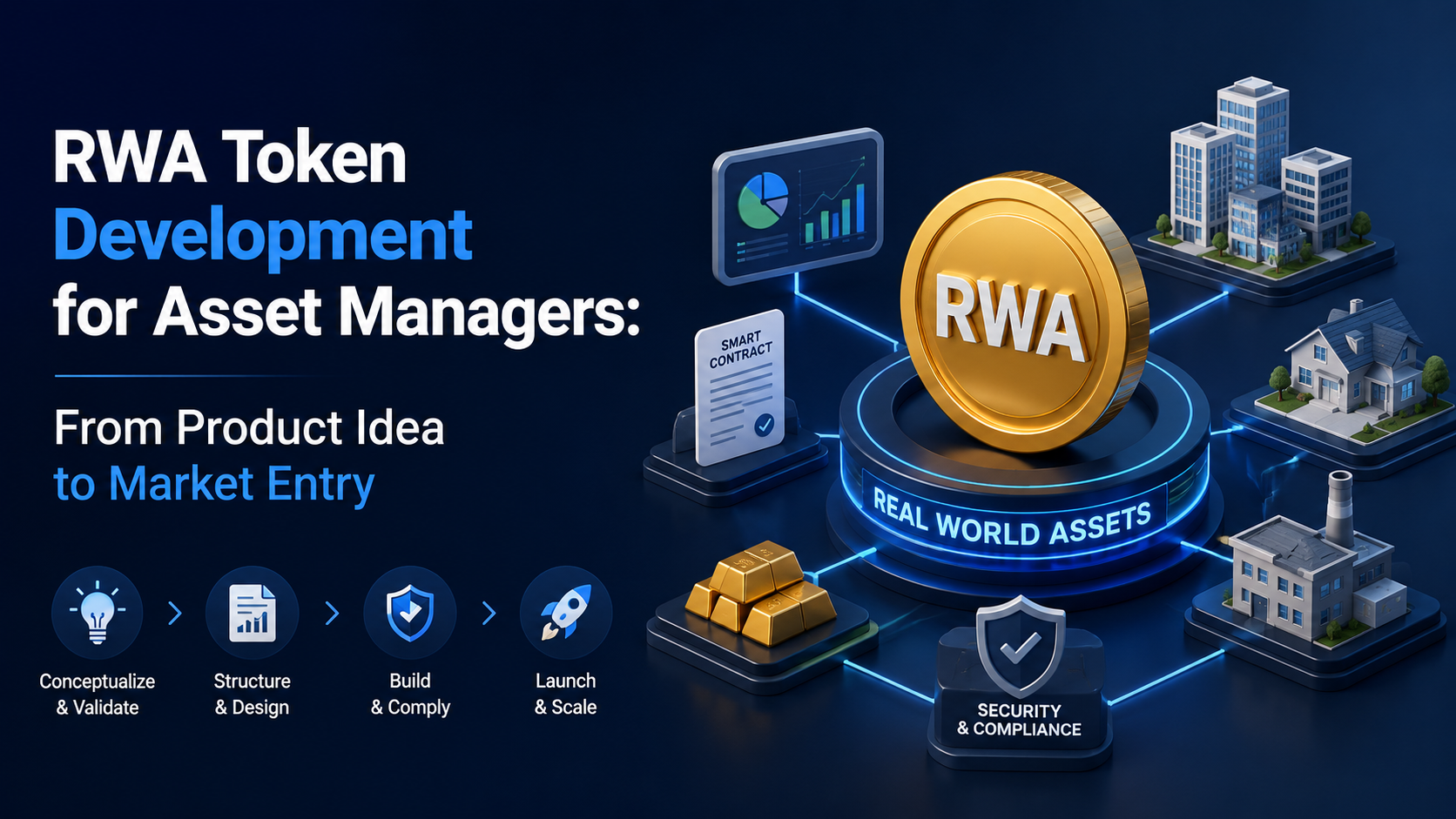
Asset managers are looking at blockchain for more than digital asset trading. The growing interest in Real World Asset Tokenization is creating new ways to represent property, private credit, commodities, funds, infrastructure, artwork, and other off-chain assets as digital tokens. For asset managers, this can create a product structure where ownership rights, investment interests, or economic claims are represented through blockchain-based assets.
RWA token development gives asset managers a way to move from an initial product concept to a functioning investment platform. However, the process involves much more than creating a token contract. Asset selection, legal structure, investor eligibility, custody, compliance, token economics, smart contract design, platform functions, secondary trading, and market distribution all influence the final product.
For an asset manager, the objective is not simply to issue a token. The product needs to fit an investment strategy and provide a practical experience for issuers, investors, administrators, and compliance teams. This article explains the process of taking an RWA product idea through development and toward market entry.
Start With the Asset and Investment Product
The first stage is deciding what the token will represent. An asset manager may consider commercial property, private debt, treasury instruments, commodities, infrastructure projects, art, funds, or other assets with measurable economic value. Each asset class brings different ownership structures, documentation requirements, valuation practices, and investor considerations.
The product idea should also define how investors participate. A token could represent fractional ownership, a fund interest, a debt claim, revenue participation, or another legally defined right. The relationship between the physical or financial asset and the digital token should be documented before software development begins.
This stage is also useful for defining the intended investor group. A product aimed at institutional investors may require different onboarding, reporting, custody, and transaction processes than a product intended for accredited or retail investors. These decisions influence the later design of the token and platform.
Select the Right Tokenization Model
After selecting the asset, the asset manager needs to decide how token ownership will work. Several models can be used in Real World Asset Tokenization. Direct ownership, special purpose vehicle structures, fund-based models, debt instruments, and contractual claims are among the approaches that may be considered.
The selected structure should explain what an investor actually receives after purchasing tokens. It should also address voting rights, income distribution, redemption conditions, transfer restrictions, and the relationship between the token holder and the underlying asset.
For example, a property token may represent an interest in an entity that owns a building rather than direct ownership of the building itself. A private credit token may represent a claim against a lending vehicle. These distinctions have an impact on legal documents, smart contracts, investor disclosures, and platform operations.
Plan the Legal and Compliance Framework
Regulatory planning is one of the most important stages in RWA token development. Tokenized products can fall under securities, investment, fund, property, commodities, or other financial regulations depending on the jurisdiction and product structure.
Asset managers should work with qualified legal and compliance professionals to determine the classification of the token and the rules that apply to its issuance and distribution. Investor verification, KYC, AML checks, suitability requirements, transfer restrictions, reporting, tax documentation, and record keeping may all form part of the product.
The compliance framework should also define which investors can access the product and where they can participate. Restrictions can then be reflected within the platform and smart contract logic where appropriate.
Design the Token Economics
Token economics explain how the digital asset relates to the investment product. For asset managers, this includes the total token supply, token price, minimum investment, distribution method, income allocation, redemption model, and transfer rules.
A token can represent a fixed portion of an asset or investment vehicle. For example, a fund worth $10 million could issue 10 million units at an initial value of $1 each. The exact structure depends on the legal and financial arrangement.
The asset manager should also determine whether tokens can be transferred between verified investors. If secondary transactions are permitted, rules may be required for eligible buyers, holding periods, geographic restrictions, and transaction limits.
A well-defined economic model helps investors understand what they are purchasing and how returns may be generated. It also gives the development team a specific framework for smart contract and platform implementation.
Develop the Smart Contract Layer
Smart contracts manage many of the token's on-chain functions. During RWA tokenization development, developers can create contracts for token issuance, transfers, ownership records, distributions, whitelisting, redemption, and administrative controls.
The contract design should match the legal structure rather than treating the token as a standalone digital asset. For regulated products, transfer restrictions can be incorporated so that only approved wallet addresses can hold or receive tokens.
Different token standards may be considered depending on the blockchain network and product requirements. The selection should account for wallet compatibility, transaction costs, ecosystem support, compliance functions, and future platform requirements.
Before deployment, contracts should go through code review and security testing. Independent smart contract audits can also be used to identify vulnerabilities before the product reaches investors.
Develop the RWA Investment Platform
The token is only one component of an asset management product. A complete rwa tokenization platform development project may include investor onboarding, asset listings, portfolio views, transaction management, compliance checks, document access, payment processing, token custody, reporting, and administrative controls.
The investor interface should provide information about the asset, offering terms, risks, token supply, valuation, distributions, and transaction history. Asset managers need administrative tools to manage investors, offerings, documents, distributions, and token activity.
An administrator dashboard can also provide access to compliance records, wallet permissions, transaction data, asset information, and operational reports. These functions reduce the need for separate systems when managing a tokenized investment product.
Connect Off-Chain Assets With On-Chain Records
RWA products depend on a connection between blockchain records and real-world assets. This requires reliable information about asset ownership, valuation, income, liabilities, and other relevant data.
For example, a tokenized property platform may need property valuation updates, rental income records, ownership documentation, and distribution information. A private credit product may require loan balances, repayment schedules, interest calculations, and borrower information.
The platform can use approved data sources, administrators, custodians, or oracle systems to update relevant information. The specific approach depends on the asset class and legal arrangement.
Create Investor Onboarding and Compliance Workflows
Investor onboarding is another major part of RWA Tokenization Services. Unlike many unrestricted blockchain applications, regulated tokenized products often require investors to pass identity and eligibility checks before purchasing tokens.
The platform can include registration, identity verification, KYC, AML screening, accreditation checks, jurisdiction checks, document collection, and wallet verification. Once approved, the investor can receive permission to access a specific offering.
This approach can also support different investor categories. For example, an asset manager may create separate access rules for institutional investors, accredited investors, or other approved participants.
Add Asset Servicing and Distribution Functions
After tokens are issued, asset managers still need to manage the underlying investment. Token holders may receive rental income, interest, dividends, redemption proceeds, or other payments depending on the product.
The platform can record these events and calculate investor allocations according to token holdings or the relevant investment agreement. Distribution systems may support stablecoins, bank payments, or other approved payment methods.
Investor reporting is also important. Statements, transaction records, income history, asset updates, and tax-related documents can be presented through the investor portal.
These functions turn tokenization from an issuance exercise into an ongoing asset management process.
Test the Product Before Market Entry
A pilot launch can help asset managers evaluate the product before opening it to a wider investor group. A limited offering can involve a selected set of investors, a smaller asset pool, or a controlled geographic market.
Testing should cover onboarding, wallet verification, token purchases, transfers, distributions, redemptions, administrative actions, and reporting. The team can also review how investors interact with the platform and where manual processes remain.
Security testing should cover both smart contracts and the wider application. API connections, user accounts, payment systems, wallets, databases, and administrative permissions all need attention.
A pilot can provide practical information about transaction volumes, investor questions, operational workloads, and compliance procedures before broader distribution begins.
Prepare the Market Entry Strategy
Once the product has passed technical, legal, and operational reviews, the asset manager can prepare for market entry. This involves defining the offering size, investor acquisition channels, pricing, communication materials, distribution partners, and launch geography.
Working with an RWA Tokenization Company can give asset managers access to development, token issuance, platform integration, and technical support under one project structure. However, the asset manager should retain control over the investment thesis, asset selection, regulatory decisions, and investor proposition.
An RWA tokenization development company may also provide separate development phases for the token, platform, compliance modules, custody integration, and secondary market functions. This approach can be useful when the product is expected to expand after its initial launch.
Select the Right Development Partner
Choosing an RWA tokenization development company requires more than checking blockchain development experience. Asset managers should assess experience with token standards, smart contracts, investor platforms, compliance workflows, custody systems, payment integration, asset data, and financial applications.
RWA tokenization development services may cover product architecture, token design, smart contract development, platform development, wallet integration, compliance modules, testing, deployment, and post-launch maintenance.
The partner should also understand that tokenized financial products involve both blockchain and conventional financial processes. A project may require integrations with KYC providers, custodians, banking systems, accounting platforms, identity services, market infrastructure, and reporting systems.
Plan for Post-Launch Operations
Market entry is not the final stage. Asset managers need processes for asset updates, investor support, compliance reviews, distributions, reporting, token transfers, redemptions, and technical maintenance.
The platform should also be prepared for changes in the asset portfolio. New assets may be added, new investor groups may be introduced, and additional jurisdictions may become relevant. Product governance should define who can approve these changes and how they are recorded.
Regular smart contract reviews, application monitoring, access management, and security assessments can help maintain the platform after launch. Asset managers should also maintain accurate documentation for investors and regulators.
Conclusion
RWA token development gives asset managers a practical route from an investment product idea to a blockchain-based market offering, but the process requires attention to assets, legal structures, investor rules, token economics, smart contracts, platform functions, compliance, asset servicing, and post-launch operations. RWA Tokenization can support products across property, private credit, funds, commodities, and other asset categories when the token structure matches the underlying investment arrangement. Real World Asset Tokenization Services can cover the technical and operational requirements needed to issue and manage these products, while RWA tokenization platform development can bring investor onboarding, token management, reporting, and administration into one environment. Blockchain App Factory provides RWA tokenization development services for businesses looking to plan, develop, test, and launch tokenized asset products based on their business and regulatory requirements.
FAQs
1. What is RWA token development for asset managers?
RWA token development involves creating blockchain-based tokens that represent ownership interests, investment rights, debt claims, or other economic interests connected to real-world assets.
2. Which assets can asset managers tokenize?
Asset managers can consider real estate, private credit, commodities, funds, infrastructure, artwork, and other assets, subject to the applicable legal and regulatory framework.
3. What does RWA tokenization development include?
RWA tokenization development can include token design, smart contracts, investor onboarding, compliance features, wallet integration, asset management functions, payment systems, reporting, testing, and deployment.
4. Why do asset managers need an RWA platform?
An RWA platform can provide a single environment for investor onboarding, token issuance, asset information, transactions, distributions, reporting, and administrative activities.
5. What are RWA Tokenization Services?
RWA Tokenization Services cover technical and business requirements involved in representing real-world assets through blockchain-based tokens, from product planning through platform deployment.
6. How does Real World Asset Tokenization work?
Real World Asset Tokenization connects an off-chain asset or investment arrangement with digital tokens. The token's rights and restrictions are defined through legal agreements and blockchain systems.
7. What should asset managers consider before launching an RWA product?
They should consider the asset structure, investor type, jurisdiction, regulatory classification, token economics, custody, compliance, smart contract design, platform functions, and ongoing asset servicing.
8. Can tokenized assets support secondary trading?
Yes, where legally permitted. A tokenized product can include transfer mechanisms for approved investors, subject to applicable securities, jurisdictional, and platform rules.